From Policy to Practice: Country Perspectives on Integration in a Constrained Financing Landscape
As global health financing tightens, countries are increasingly being asked to do more with less. A stronger focus on integration is emerging as part of the Global Fund to Fight AIDS, Tuberculosis and Malaria response. In this shifting landscape, the Africa Constituency Bureau (ACB) convened a country consultation on 8 April to facilitate peer learning and reflection on advancing the integration of HIV, TB, and malaria programmes within broader health systems.
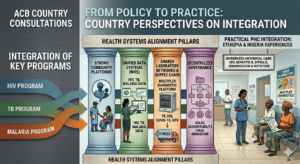 Bringing together country representatives and partners, the discussion offered timely insights as countries prepare for the next funding cycle under Grant Cycle 8 (GC8).
During the discussions, there was broad recognition that integration is no longer simply a policy aspiration. With declining donor funding and increasing emphasis on sustainability, efficiency, and co-financing, integration has become a practical necessity. Yet while the direction is clear, the pathway is less so. Countries are navigating how to transition from historically vertical programmes toward more integrated systems without undermining the gains achieved over the past two decades.
Integration in Ethiopia: A Long-Term, System-Based Approach
Ethiopia’s experience stood out as a strong example of how integration can be anchored in a broader health system vision. Building on decades of commitment to primary health care (PHC), the country has adopted a deliberate approach that prioritizes integration at the PHC level while maintaining the integrity of disease-specific programmes.
In practice, this means HIV and TB prevention services are available across lower-level facilities, while malaria services are integrated in high-burden areas. Integration in Ethiopia does not imply merging programmes, but rather aligning them through shared system pillars, laboratory networks, supply chains, community platforms, and data systems.
This reflects a clear strategic choice: integration as coordination and optimization, not uniformity. Following Global Fund guidance, Ethiopia plans to submit a single, integrated funding request under GC8, with multiple components aligned across disease programmes and health systems priorities.
The use of unified platforms, such as a national health information system, integrated supply chains, and a strong community health extension programme, demonstrates how efficiencies can be achieved without losing programmatic focus.
At the same time, Ethiopia’s experience highlights persistent challenges: aligning programmes with different donor cycles, managing competing priorities, and ensuring clarity in roles and accountability. There is also a risk that expanding service packages without adequate capacity may affect quality of care. For example, adding new services to already stretched community health workers requires not only additional training but also stronger supervision. Even in strong systems, integration demands careful sequencing and continuous adjustment.
Integration in a Decentralized Context: The Nigerian Experience
Nigeria offers a complementary perspective, illustrating how integration unfolds in a complex, decentralized system. Since 2022, efforts to move away from siloed HIV programmes have yielded measurable results.
A key focus has been the integration of HIV, hepatitis, and syphilis services into antenatal care, supporting a “triple elimination” approach. Screening for mothers and infants has also been integrated into immunization, nutrition, and outpatient services.
In parallel, broader efforts have integrated sexual and reproductive health with communicable diseases, including HIV, TB, malaria, hepatitis B and C, sexually transmitted infections, and cervical cancer screening. across primary and secondary care facilities, targeting populations such as people living with HIV, adolescents and young people, key populations, and pregnant women.
Integration has also extended to inputs and technologies. Diagnostic platforms such as GeneXpert, initially procured for multidrug-resistant TB, are now used for multiple purposes, including COVID-19 testing, HIV early infant diagnosis, viral load testing, cervical cancer screening, and emerging threats such as Mpox and influenza.
However, challenges remain. Uneven implementation across states, persistent data fragmentation, and the complexity of service delivery in higher-level facilities highlight the difficulties of translating policy into practice.
Beyond One-Size-Fits-All Approaches
These country experiences reinforce a central message: integration is not a one-size-fits-all model. It must be shaped by country context, health system structure, and implementation capacity. In practice, this often means adopting phased approaches, prioritizing high-impact areas such as primary care, laboratory systems, or supply chains, rather than attempting comprehensive integration from the outset.
The Weight of Legacy Systems
Decades of disease-specific investments have created parallel structures in financing, procurement, data systems, and workforce organization. While these parallel systems have delivered significant results, they also complicate the transition to integrated models. Countries must therefore strike a balance between preserving programme effectiveness and improving efficiency and coherence.
Financing remains a critical constraint. Although integration is widely promoted, funding streams are still largely disease-specific, shaping planning and implementation decisions like with the Global Fund grant resources. Participants emphasized the need for more holistic investment approaches, particularly at subnational level, where alignment between domestic and external resources is essential.
Integration Requires More Than Technology
Technology and innovation are important enablers, but not substitutes for systemic reform. Multiplex diagnostic platforms, integrated data systems, and digital training tools demonstrate how existing infrastructure can support multiple health priorities. However, without aligned governance, financing, and accountability frameworks, these gains will remain limited.
A Pragmatic Path Forward
As countries move closer to GC8, there is growing recognition that integration must be approached pragmatically. It requires clear definitions, realistic expectations, and strong national leadership to coordinate across sectors and partners. It also requires acknowledging that integration has limits, and that hybrid models, where integrated and disease-specific approaches coexist, may be necessary.
By convening this consultation, the ACB has provided a valuable platform for countries to move beyond policy statements and engage with implementation realities. The exchange highlighted not only what is working, but also the trade-offs, constraints, and unresolved questions shaping the integration agenda.
Ultimately, the shift toward integrated health systems will not be driven by a single model. It will depend on countries defining their own pathways, grounded in their realities and informed by shared learning. As financial pressures intensify, such country-led dialogue will be essential to shaping integration strategies that are both practical and sustainable in the lead-up to GC8 and beyond.