Strengthening Financial Sustainability in Global Health: The Evolving Role of Public Financial Management and Co-Financing
Strengthening Financial Sustainability in Global Health: The Evolving Role of Public Financial Management and Co-Financing
As global health funding becomes more constrained, Global Health Institutions and countries are under increasing pressure to strengthen domestic resources for health and integrated the funded programs with national systems to ensure the long-term sustainability of their health systems. In this changing environment, Public Financial Management (PFM) and co-financing are becoming central to how the Global Fund and countries plan, finance, and sustain essential health services. The conversation is no longer only about mobilizing more resources, but also about how effectively those resources are managed, aligned with national priorities, and invested to deliver lasting health outcomes.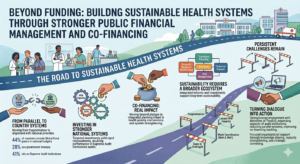
Across Africa and other regions, governments and development partners are increasingly recognizing that sustainability is not only about raising more money for health. It is also about ensuring that available resources are managed efficiently, aligned with national priorities, and invested in ways that deliver lasting results.
All these discussions are essential as countries seek to strengthen the resilience of their health systems in a context of limited external resources.
Moving from Parallel Systems to Country Systems
For many years, global health programs often operated through parallel financial and reporting systems created by external donors. While these systems aimed to accelerate implementation, they also created fragmentation, duplication, and long-term dependency.
Today, with reduced donor funding, there is a growing shift toward greater country systems. Under the Global Fund’s 2023–2028 Strategy, countries and partners are working to integrate external financing more closely into national systems. In this context, PFM is no longer seen as a purely technical issue for accountants and auditors. It is increasingly viewed as a strategic tool to improve efficiency and value for money, strengthen accountability and transparency and support long-term sustainability and transition from donor funding
Encouraging signs of progress are already visible. Currently, 44% of countries include Global Fund grants in national budgets, 28% use government treasury systems for grant implementation, and 41% rely on Supreme Audit Institutions for grant audits in Africa.
These developments reflect growing use and confidence in country systems, although important gaps and challenges remain.
Investing in Stronger National Systems
One of the most promising trends in recent years has been the use of targeted catalytic investments to strengthen financial management systems.
In just three years, performance related to audits conducted by Supreme Audit Institutions has doubled. This demonstrates that focused investments, combined with strong national leadership, can produce rapid and measurable improvements.
Several factors have helped drive this progress. Among them are strong partnerships with regional audit institutions, leadership from Auditors General from the countries, regular dialogue between ministries, donors, and oversight bodies and continuous monitoring and learning to improve performance over time.
These experiences show that resilient systems are not built overnight, but they can be strengthened significantly when investments are aligned with national institutions and priorities.
Co-Financing: From Pledges to Real Impact
Co-financing has long been a core part of the Global Fund model, which since its inception has insisted on the principle of additionality: the Global Fund expects to add to countries’ resources, not to substitute for them.
As the Global Fund pushes countries to invest more in health, it also questions how effectively those resources are used. Increasingly, co-financing is integrated earlier into the grant planning process, linked to priority interventions and health system strengthening and used to encourage reforms and improve accountability.
This reflects a broader understanding that co-financing is not simply a funding condition. It is part of a wider effort to build sustainable health financing systems that can endure beyond external support. Better, the Global Fund has acknowledged that in most countries, the proportion of health expenses that it covers is small compared to the government budget.
Sustainability Requires More Than Funding Alone
PFM, co-financing, and domestic resource mobilisation do not operate in isolation. They are part of a broader ecosystem of reforms and investments that together support stronger and more sustainable health systems.
These include domestic resource mobilization and health financing advocacy, better management of financial risks within health programs, technical support and strategic policy advice, innovative financing approaches including blended finance, stronger health financing data and information systems, transition planning for countries reducing dependence on donors and better alignment between external funding and national priorities.
Together, these efforts contribute to a common goal: ensuring that health resources are spent more effectively, national systems are strengthened, and countries become less dependent on external aid over time.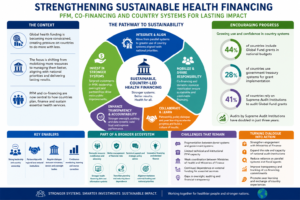
Persistent Challenges Remain
Despite important progress, many countries continue to face significant structural barriers.
These include:
- Fragmentation between donor systems and government systems
- Limited technical and institutional PFM capacity
- Weak coordination between Ministries of Health and Ministries of Finance
- Continued dependence on external funding for essential services
- Gaps in oversight, auditing, and financial transparency
Addressing these challenges will require long-term political commitment, stronger institutions, and closer collaboration across sectors.
Turning Dialogue into Action
Recent discussions among African constituencies and partners have highlighted several priorities for the future. They are strengthening engagement with Ministries of Finance, expanding the role and capacity of national audit institutions, reducing reliance on parallel systems, including fiscal agents, improving transparency and tracking of co-financing commitments and promoting peer learning and exchange of country experiences
Organizations such as the Africa Constituency Bureau also have an important role to play in supporting countries through knowledge sharing, capacity strengthening, and strategic convening.
Conclusion
The transition toward sustainable health financing is no longer a future aspiration, it is already happening.
Public Financial Management, co-financing, and domestic resource mobilization are no longer niche technical discussions reserved for specialists. They are now central to how countries plan, finance, and sustain their health systems.
The progress achieved so far shows that meaningful change is possible. The next phase will depend on how effectively countries and partners can scale successful approaches, strengthen weak systems, and work together around a shared vision of sustainable, country-led health financing.