Navigating Change: What the Global Fund’s Strategic Shift Means for Africa and Global Health
The 54th Board Meeting of The Global Fund to Fight AIDS, Tuberculosis and Malaria marked more than a governance milestone. It confirmed what many in global health have sensed for several years: the financing and political architecture that defined the past two decades is changing.
With replenishment resources falling short of the original target and donor governments operating under fiscal constraints, the Global Fund is recalibrating. The language of the institution is shifting from scale-up to optimization, from expansion to efficiency, and from external financing to sustainability and transition.
For Eastern and Southern Africa (ESA) and West and Central Africa (WCA) constituencies, this shift is not abstract. It will shape the trajectory of HIV, tuberculosis, and malaria across the continent, where the burden of disease remains highest and demographic pressures are intensifying.
This is a turning point, not only for Africa, but for the global health compact itself.
The End of Automatic Expansion
For two decades, the Global Fund symbolized rapid scale-up: antiretroviral therapy expansion, insecticide-treated net distribution, TB diagnostics, and community-led responses reaching millions.
Today, the conversation is different.
Board deliberations emphasized program optimization, greater use of national systems, transition planning for upper-middle- and lower-middle-income countries, domestic resource mobilization, and integration into primary health care.
The era of predictable external growth financing has ended. The next phase demands sharper prioritization.
For Africa, which receives roughly 70% of Global Fund resources, the implications are profound. Several ESA countries are classified as upper-middle income yet carry some of the world’s highest HIV prevalence rates. Most WCA countries remain low-income and fragile, with limited fiscal space to absorb transition shocks.
Income classification does not always align neatly with epidemiological reality.
Sustainability: Necessary, but Unequally Feasible
The strategic pivot toward sustainability reflects legitimate considerations. Long-term dependency on external financing is neither politically nor economically viable for donors. But sustainability must be grounded in context.
Across much of Africa, debt burdens constrain fiscal space; climate change is disrupting malaria patterns; conflict and displacement strain health systems; and youth populations are expanding rapidly.
Domestic resource mobilization is essential, but it cannot compensate overnight for reduced external support. Transition timelines must reflect system capacity, disease burden, and macroeconomic conditions.
The retreat of donors also implies the integration of services that were previously siloed into national systems.
Integration: Promise and Peril
Integration, moving from vertical disease programs toward integrated service delivery within national health care systems , was discussed as the way forward. Conceptually and practically, this is sound. Integrated systems can improve efficiency, reduce duplication, and strengthen resilience.
However, integration requires investment to avoid overwhelming fragile systems. In many African countries, HIV and TB programs in particular have operated on separate platforms with their own staff, data systems, laboratories, procurement channels, and supply chains.
Integrating these functions into national systems can strengthen the overall system but, if under-resourced, it may weaken service delivery for all, especially for populations previously served through donor-supported platforms.
Communities: The Sustainability Blind Spot
One of the most consequential issues is the future of community systems.
In many African countries, civil society organizations and community health actors are funded almost exclusively by donors. These actors deliver adherence support, reach key populations, combat stigma, and extend services into marginalized communities.
As sustainability discussions advance, a critical question emerges: Who will finance community systems when donors step back?
Without mechanisms such as social contracting and domestic budget allocation for civil society, the very actors that drove HIV and TB progress risk being left behind.
Sustainability that excludes communities is structurally incomplete.
Governance and Health Sovereignty
The evolving model increasingly centers on the use of national systems. This is a welcome development from an African perspective. Parallel implementation units and externally managed systems have often limited institutional strengthening.
But sovereignty carries responsibility.
Stronger national systems demand, in addition to responsiveness to patient needs, robust financial management, transparent budgeting, inclusion of Global Fund financing in national budgets, and political leadership that extends beyond ministries of health.
The sustainability conversation must move from technical dialogue to whole-of-government engagement, including ministries of finance and heads of state.
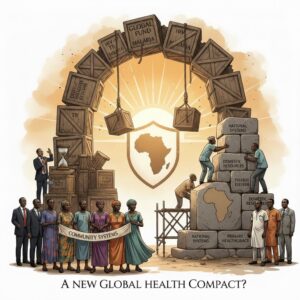
A New Global Health Compact?
At its core, the 54th Board Meeting signaled a transition in the implicit contract between donors and implementers.
The earlier phase of global health was built on solidarity and rapid scale-up. The emerging phase emphasizes co-investment, accountability, and national leadership.
For Africa, this is both a challenge and an opportunity.
The continent can evolve:
- From primary beneficiary to co-investor
• From program implementer to system architect
• From aid recipient to governance influencer
But this transition must be managed carefully, or it risks widening inequities between countries able to absorb reforms and those still grappling with fragility.
The Central Question
The Global Fund’s founding mission remains unchanged: to save lives threatened by HIV, TB, and malaria. Over the last two decades, HIV has evolved from a near-certain death sentence into a manageable chronic condition. Progress has been made in the fight against TB, while malaria remains stubbornly persistent, even as mortality has declined.
The Global Fund has been a powerful agent in these transformations, alongside scientific advances, donor generosity, and the adaptability of implementers.
The central question now is how the Global Fund partnership should evolve at a time when donors continue to contribute but increasingly request exit strategies, while implementers call for greater health sovereignty.
Conclusion
The future of the Global Fund partnership will not be defined by the volume of resources alone, but by how effectively countries and partners navigate this transition. Sustainability must be sequenced, systems must be strengthened before responsibilities are transferred, and communities must remain central to the response. If managed with realism and solidarity, this shift can mark the maturation of the global health compact from one rooted in emergency response to one grounded in shared responsibility, resilience, and country-led health sovereignty.