Africa’s Voice at the 55th Global Fund Board Meeting: Advancing Country Ownership, Sustainability, and Impact
The global health community is navigating a period of unprecedented change. Declining official development assistance, shifting geopolitical dynamics, increasing pressures on health financing, and growing expectations for countries to lead and sustain their health responses are collectively reshaping the global health architecture.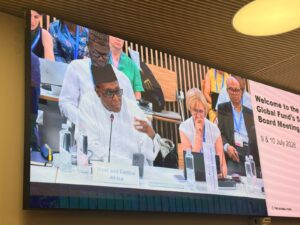
The 55th Global Fund Board Meeting, held on 9–10 July 2026, took place against this rapidly evolving backdrop. Throughout the discussions, the Eastern and Southern Africa (ESA) and Western and Central Africa (WCA) constituencies advanced a shared vision: a Global Fund that remains fiercely focused on its core mission of saving lives while proactively adapting to a changing operating environment.
Representing 46 Sub-Saharan African countries, the ESA and WCA constituencies emphasized that the next phase of the Global Fund partnership must place country leadership, stronger health systems, sustainability, and equitable access at the very center of decision-making. These constituency voice and opinion should matter in the Global health ecosystem. More than three-quarters of the Global Fund resources are invested in Africa. As the Secretariat supporting these two constituencies, the African Constituency Bureau (ACB) continues to facilitate evidence-based policy engagement, strategic coordination, and targeted advocacy to ensure that African priorities are effectively reflected in Global Fund governance and decision-making.
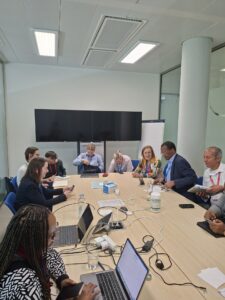 Strategic engagements on the margins of the Board Meeting further reinforced these themes. In discussions with non-African constituencies including donor countries, civil society representatives, and philanthropic partners, ESA and WCA highlighted the importance of a transition towards stronger country leadership, sustainable financing, and resilient national systems. There was broad recognition that country ownership must go beyond the transfer of responsibilities and be supported by effective governance, public financial management, accountability mechanisms, and inclusive participation of communities and civil society.
Discussions also reflected growing interest in strengthening African-led solutions, including regional approaches to health product manufacturing, market shaping, procurement, and knowledge exchange. The importance of stronger coordination among global health actors and regional institutions, including Africa CDC and ACB, was underscored to ensure that partnerships are better aligned with country priorities and deliver greater impact.
Making Difficult Choices While Protecting Impact
The current constrained financial environment requires the Global Fund partnership to make incredibly difficult choices. ESA and WCA recognized the need for greater operational efficiency, simplification, and strategic prioritization to ensure that available resources generate maximum impact.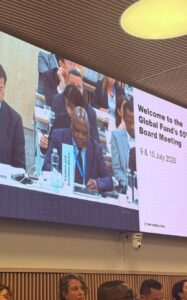
At the same time, the constituencies stressed that efficiency reforms must remain anchored in the Global Fund’s core humanitarian mission and assessed primarily against their impact on countries and communities on the ground. Reducing administrative complexity, streamlining processes, and improving partner coordination should ultimately strengthen, not weaken the ability of countries to implement life-saving programs.
Strengthening Risk Management Through Differentiated Support
The Global Fund Secretariat proposed an evolved version of the Risk Appetite Framework. ESA and WCA welcomed the new framework as an invaluable opportunity to strengthen strategic decision-making in a more complex global environment. The constituencies supported a more balanced approach that recognizes the need to manage fiduciary and programmatic risks while still enabling innovation, country leadership, and impact.
As greater responsibility shifts toward national systems and domestic implementers, risk management approaches must also evolve. Differentiated implementation and assurance models are particularly critical for countries operating in challenging, complex, or fragile environments, where local realities require tailored, flexible solutions rather than uniform, one-size-fits-all approaches.
Building Sustainable Access to Health Products
A defining outcome of the 55th Board Meeting was the approval of the Non-Global Fund-Financed Procurement Mechanism (NGFPM). Operating as a ring-fenced financing mechanism, separate from core Global Fund grant resources, the NGFPM expands the existing platform through which countries can procure quality-assured health products using domestic resources or third-party financing. Importantly, the policy also allows eligible regional pooled procurement mechanisms to access the platform, creating new opportunities for collaborative procurement.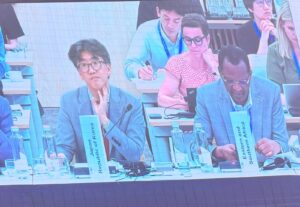
The ESA and WCA constituencies welcomed the mechanism as an additional option rather than a one-size-fits-all solution. They emphasized that procurement approaches should reflect countries’ varying capacities and contexts. While countries with mature procurement systems should retain the flexibility to use national mechanisms, others may choose to benefit from the Global Fund’s procurement platform and its pre-financing facility to address liquidity and cash-flow constraints. This differentiated, voluntary approach supports a gradual transition towards greater procurement sustainability while safeguarding access, affordability, quality, and security of supply.
Finaly the constituencies advocated for measures that increase opportunities for African manufacturers to participate in Global Fund-supported markets and emphasized that implementation of the new policy should complement, rather than undermine emerging regional pooled procurement mechanisms led by continental institutions.
Strengthening Collaboration Across the Global Health Ecosystem
Finally, ESA and WCA welcomed continued, deepened collaboration between the Global Fund and other global health partners, including the WHO, Gavi and the World Bank. The constituencies highlighted that these partnerships must deliver practical, tangible value at the country level by reducing fragmentation, streamlining reporting metrics and aligning grant timeliness, partners can drastically reduce the administrative burden currently straining national health ministries. True partnership must shift away from fragmented disease silos toward a singular, robustly supported national health system. As global health initiatives evolve, African perspectives must remain central to discussions on how partners can work more effectively together to achieve sustainable health outcomes.
Africa’s Voice in Shaping the Future of Global Health
The discussions at the 55th Global Fund Board Meeting reflected both the immense challenges and the historic opportunities facing the global health community. Africa is not merely a major recipient of Global Fund investments, it is an indispensable partner in shaping how global health priorities are defined, financed, and implemented.
Through the leadership of the ESA and WCA constituencies, supported by the African Constituency Bureau, African countries continue to advocate for a Global Fund partnership that is responsive to country realities, champions national leadership, and delivers sustainable impact. As the Global Fund prepares for its next strategic phase, ACB remains deeply committed to amplifying Africa’s voice and ensuring that the continent’s priorities remain at the heart of the partnership.
For more information, please contact:
 Fassika Alemayehu, Advocacy and Communication Lead
AFRICAN CONSTITUENCY BUREAU FOR THE GLOBAL FUND
A: Africa Centres for Diseases Control and Prevention Headquarters
16/17 Nefas Silk Lafto, Addis Ababa, Ethiopia
M:+251923292164
E: falemayehu@africabureau.org
W: africanconstituency.org